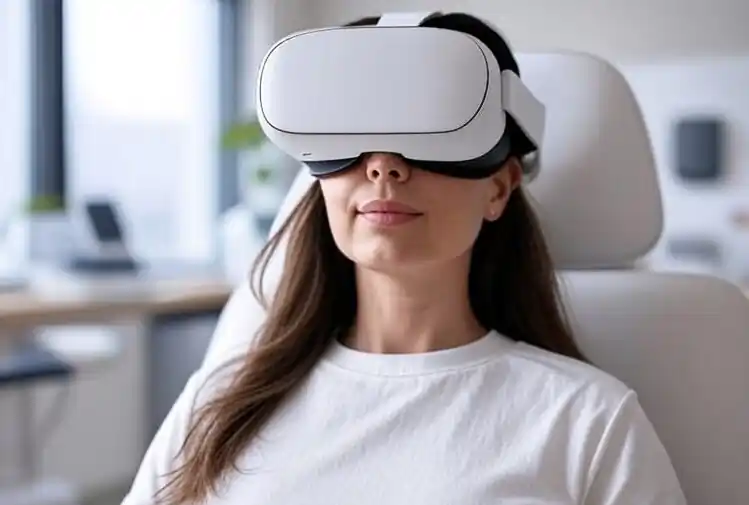
Virtual reality in physiotherapy rehabilitation is emerging as a promising innovation in contemporary clinical practice. It is transforming how healthcare professionals support their patients by combining technology, engagement, and therapeutic efficacy. This technological tool improves adherence, reduces pain, and enhances the effectiveness of care, while gradually integrating with traditional approaches.
Faced with a growing demand for personalized and interactive care, physiotherapists are exploring ways to optimize clinical outcomes. Virtual reality facilitates this transition to a more patient-centered therapeutic approach. Strategically integrated, it offers a modern response to the complex needs of rehabilitation, although it is not yet widely deployed in routine clinical practice.
Summary
- What is virtual reality in rehabilitation?
- Clinical Benefits and Applications
- Specific applications by pathology
- Telerehabilitation and potential in the office
- Practical implementation and technical considerations
- Phyzio.ch: Supporting technological innovation in practice
- Ethical issues and future prospects
- Conclusion
- FAQ
What is virtual reality in rehabilitation?
Virtual reality (VR) in physiotherapy rehabilitation involves immersing the patient in a 360-degree simulated digital environment. Using VR headsets, motion sensors, and interactive software, the patient is invited to perform targeted exercises, often transformed into therapeutic games. This immersion aims to stimulate both motor and cognitive abilities in a controlled and motivating environment.
Technological components
A therapeutic virtual reality system typically includes:
- VR headset: Immersive display device with high-resolution screens
- Motion sensors: Position and gesture detectors for natural interaction
- Specialized software: Applications dedicated to therapeutic exercises
- Control interface: Tools allowing the therapist to configure and monitor sessions
- Audio system: Sound feedback to guide and motivate the patient
Principle of therapeutic immersion
These environments can replicate real-life situations (walking in a park, climbing stairs, grasping an object) while providing immediate visual feedback on the patient's performance. The programs are designed to adapt to each individual's motor and cognitive abilities, thus offering a personalized and progressive experience.
VR allows for continuous and precise progress assessment, enabling instant adjustment of exercise parameters: intensity, duration, range of motion, and frequency. This allows for precise calibration of the intervention according to the patient's specific needs.
Different types of virtual reality
- Immersive VR: A full-face headset that completely isolates the patient from the real world.
- Semi-immersive VR: Large-format screens allowing for partial immersion
- Augmented reality: Superimposing virtual elements onto the real environment
- Mixed reality: Interactive combination of real and virtual elements
Clinical Benefits and Applications
Membership and motivation
According to several recent studies, virtual reality in physiotherapy rehabilitation significantly improves adherence to exercises. This increase is due to the immersive, playful, and engaging nature of the tool, which transforms repetitive movements into stimulating challenges.
Patients experience immediate satisfaction when they see their progress on the screen. Gamification elements—such as achievement-based progression and interactive tasks—make the exercises engaging and rewarding. Having real-time visual and auditory feedback on movements stimulates motivation to persevere and reduces early treatment dropout rates.
Motivation mechanisms:
- Immediate feedback on performance
- Progressive and achievable goals
- Virtual rewards and encouragement
- Variety of environments and exercises
- A sense of control and autonomy
Reduction of pain and kinesiophobia
A recent meta-analysis indicates that VR significantly reduces the perception of pain during various medical procedures, with mean standardized effects of -0.77 to -0.86. This relief is explained by cognitive distraction: immersion in an alternative universe diverts the patient's attention from physical pain, limiting the activation of neural circuits associated with chronic pain.
Immersive environments can generate a positive emotional response (relaxation, amusement, stimulation) that interferes with pain signals. Some platforms allow the complexity of the environments to be adapted to the patient's pain level that day, optimizing patient engagement without exceeding their tolerance threshold.
Combating kinesiophobia:
By offering a safe and progressive environment, VR also effectively combats kinesiophobia. Patients, often plagued by anxiety related to movement, regain confidence in a risk-free space. They are guided by gentle visual instructions, progressive levels of difficulty, and dynamic encouragement.
Playful exercises such as virtual object hunts, simulating everyday movements, or body visualization facilitate the rediscovery of body awareness. This helps restore functional mobility and prevent prolonged avoidance behaviors.
Improvement of cognitive functions
VR simultaneously stimulates motor and cognitive functions:
- Selective attention and concentration
- Working memory and spatial memory
- Executive functions and decision-making
- Eye-hand coordination and visuomotor integration
Specific applications by pathology
Neurological disorders
Virtual reality is proving particularly useful in post-stroke rehabilitation, for patients with multiple sclerosis, Parkinson's disease, or traumatic brain injuries. It allows for the improvement of balance, coordination, fine and gross motor skills, as well as cognitive functions.
Typical exercises for neurological disorders:
- Balance course on a virtual tree trunk
- Catching balls with the arms (eye-hand coordination)
- Tracking a moving object with the eyes (eye control)
- Navigating a space to stimulate spatial memory
- Object recognition and memorization games
- Simulation of everyday life activities (cooking, dressing)
Specific benefits:
- Neuroplasticity: stimulation of brain reorganization
- Enhanced feedback: precise information on movements
- Intensive repetition: facilitating motor learning
- Gradual adaptation: adjustment according to abilities
Musculoskeletal pathologies
For lower back pain, neck pain, sprains, or post-operative recovery (knee, hip, shoulder), VR offers progressive, interactive, and motivating rehabilitation. By recreating everyday movements in a safe and controlled environment, it helps improve posture, proprioception, joint stability, and muscle endurance.
Practical applications:
- Range of motion exercises with visual feedback
- Muscle strengthening through interactive games
- Proprioceptive rehabilitation in a virtual unstable environment
- Simulation of professional or sporting activities
- Postural work with real-time correction
Studies reveal that VR interventions significantly reduce pain intensity and kinesiophobia, particularly when combined with conventional physiotherapy. Patients report greater overall satisfaction and a faster return to functional activities.
Balance problems and falls
VR offers safe environments for working on balance:
- Simulation of controlled destabilizing situations
- Training of equilibration reactions
- Improving confidence in one's abilities
- Fall prevention in the elderly
Pediatric rehabilitation
For children, VR offers particular advantages:
- Natural motivation through play
- Motor learning made easier
- Reduction of anxiety related to care
- Suitable for different age groups
Telerehabilitation and potential in the office
The tele-rehabilitation revolution
With the shift towards digitalization in medical practices, telerehabilitation is becoming an increasingly popular solution. Virtual reality integrates perfectly into this model, particularly thanks to connected platforms that allow for real-time remote monitoring.
Tools like PhysioVR (Virtualis), XR Health, and CUREO (Cureosity) offer home-based solutions with automatic feedback of performance data to the therapist. These devices expand access to care for patients in rural areas, those with reduced mobility, or those undergoing prolonged convalescence.
Advantages of VR telerehabilitation:
- Easy access to specialist care
- Continuity of care at home
- Reduction of travel and associated costs
- Objective performance monitoring
- Customizing remote programs
Integration into practice
In a clinical setting, virtual reality is becoming an extension of the technical platform. It allows for a greater variety of treatment options, reduces the physical workload of the practitioner, and enriches the patient experience. Furthermore, automated data collection enables analytical monitoring of progress: number of repetitions, precision of movements, and regularity of sessions.
Benefits for the practitioner:
- Diversification of therapeutic modalities
- Objectification of results
- Optimizing session time
- Increased patient motivation
- Competitive differentiation
Hybrid models
The future seems to be heading towards hybrid models combining:
- In-office sessions with direct supervision
- Standalone VR sessions at home
- Continuous monitoring via connected data
- Remote therapeutic adjustments
Practical implementation and technical considerations
Equipment selection criteria
The choice of VR system depends on several factors:
Technical aspects:
- Display quality: Resolution, refresh rate, motion sickness reduction
- Tracking accuracy: Precise detection of patient movements
- Ergonomics: Comfort of use, helmet weight, ease of adjustment
- Compatibility: Integration with the firm's existing systems
Clinical considerations:
- Targeted pathologies and available exercises
- Program customization options
- Collection and analysis of performance data
- Safety protocols and contraindications
Training and support
Successful VR integration requires:
- Technical training in the use of equipment
- Learning specific clinical protocols
- Understanding the indications and contraindications
- Developing skills in digital coaching
Economic aspects
Investment costs:
- VR equipment: CHF 1,000 - 10,000 depending on the sophistication
- Therapeutic software: monthly subscriptions or licenses
- Staff training: initial training costs
- Maintenance and updates
Return on investment:
- Improving the firm's attractiveness
- Competitive differentiation
- Optimizing therapy time
- Possibility of new pricing models
Contraindications and precautions
VR has certain limitations:
- Photosensitive epilepsy
- Severe vestibular disorders
- Claustrophobia
- Significant visual impairments
- Severe cognitive impairment
Phyzio.ch: Supporting technological innovation in practice
Integrating innovative technologies like virtual reality into your practice requires modern and appropriate administrative management. Phyzio.ch, as the leading Swiss physiotherapy software, supports you in this technological transition by providing the necessary tools to effectively manage these new therapeutic modalities.
Management of new therapeutic modalities:
- Specialized documentation: Ability to create specific treatment sheets for VR sessions with customized parameters
- Performance monitoring: Integration of progress data from VR devices into the patient file
- Optimized scheduling: Management of dedicated VR session slots with specific durations and equipment
- Customized billing: Ability to create personalized service codes for innovative therapies
Supporting innovation:
- Scalability: Platform designed to adapt to new technologies and therapeutic modalities.
- Data collection: Centralization of information from different therapeutic devices
- Analysis of results: Statistical tools to evaluate the effectiveness of new approaches
- Patient communication: Information and explanations on the new technologies offered
Modern practice management:
- Dashboard to track the use of VR equipment
- Planning of technological training and certifications
- Monitoring the return on investment of new equipment
- Integration with telerehabilitation systems
With Phyzio.ch, you have a management tool that evolves with your practice and allows you to seamlessly integrate technological innovations. Our platform helps you maximize your investments in new technologies while maintaining efficient administrative organization.
Technological innovation is transforming physiotherapy, and Phyzio.ch supports you in this evolution so that you can focus on what matters most: providing the best care to your patients.
To discover how Phyzio.ch can support your transition to a more technology-driven practice, visit: https://phyzio.ch/fr/logiciel-physio .
Ethical issues and future prospects
Major ethical issues
Although VR has recently been introduced into physiotherapy, its use remains limited in primary care. The increasing adoption of virtual reality in physiotherapy rehabilitation raises several important ethical and practical issues.
Data security:
The security of health data collected by connected devices is a major challenge, particularly with regard to GDPR compliance and patient information confidentiality. Biometric and behavioral data collected by VR require enhanced protection.
Equity of access:
Equitable access remains a challenge, as VR technologies can represent a significant cost for some institutions or independent practices. There is a risk of creating a digital divide in access to innovative healthcare.
Professional training:
Continuing professional development is also essential for the relevant and ethical use of these new tools. Therapists must develop new skills while maintaining their traditional clinical expertise.
Preserving the humanity of care
Another key point concerns technological dependence. While VR offers real, scientifically validated benefits, it does not replace therapeutic touch, clinical expertise, and the human connection inherent in physiotherapy. The use of virtual reality must remain complementary to traditional methods, within a clear methodological framework, with validated protocols and ongoing evaluation of its effectiveness.
Responsible use of technology
Finally, it is crucial to raise awareness among patients and therapists about the responsible use of technology. The goal is to promote informed and structured use, in which VR integrates seamlessly into daily practice without disempowering the patient.
Prospects for development
Expected technological developments:
- Improved resolution and reduced costs
- Integration of artificial intelligence for personalization
- Development of more precise and less invasive sensors
- Mixed reality combining virtual and real
Clinical developments:
- Validation of new therapeutic protocols
- Development of VR-based personalized medicine
- Integration into standardized care pathways
- Recognition and reimbursement by insurance companies
Societal impact:
- Democratizing access to specialist care
- Prevention and health promotion through VR
- Transformation of rehabilitation professions
- New professional training opportunities
Conclusion
In conclusion, virtual reality represents a promising advancement in the field of physiotherapy. By combining technology, engagement, and emerging clinical evidence, it paves the way for more modern, precise, and motivating rehabilitation. It allows healthcare professionals to offer innovative, patient-centered care adapted to the contemporary challenges of practice.
The benefits of VR are numerous: improved treatment adherence, reduced pain, optimized functional outcomes, and an enhanced patient experience. However, its integration must be carefully considered and gradual, taking into account ethical, economic, and training considerations.
The future of physiotherapy lies in a smart balance between technological innovation and preserving the human element of care. VR, used judiciously and as a complement to traditional approaches, helps to raise the quality of care while respecting the profession's fundamental values.
For practitioners wishing to explore this avenue, it is essential to undergo training, choose equipment suited to their practice, and maintain a critical and evaluative approach. Virtual reality is not an end in itself, but a tool to facilitate more effective and engaging physiotherapy.
FAQ
Which medical conditions can benefit from virtual reality?
Neurological pathologies (stroke, Parkinson's, multiple sclerosis), musculoskeletal disorders (lower back pain, post-operative rehabilitation), balance disorders, chronic pain and proprioceptive disorders are among the main indications for therapeutic VR.
Does a physiotherapist need special training?
Basic training is recommended for using virtual reality interfaces, but most tools are designed to be quickly mastered. Certifications are offered by some manufacturers. The training covers technical, clinical, and safety aspects.
Is it possible to integrate VR into a practice without major investments?
Yes. Many solutions on the market are offered through leasing or subscription, which limits initial costs. It's possible to start with a basic kit (headset, software, tablet) for a few hundred euros, and then upgrade to more sophisticated systems.
What is the difference between immersive and non-immersive VR?
Immersive VR uses a headset to fully immerse the patient in the virtual environment, while the non-immersive version is limited to interaction via a screen. The immersive experience offers greater sensory engagement and improved therapeutic outcomes.
Can VR replace traditional physiotherapy?
No, VR is a complementary tool that enhances traditional care. It does not replace therapeutic touch, clinical expertise, and the human connection essential to physiotherapy. Its use must be integrated into a comprehensive approach to care.
Are there any side effects to VR?
Some patients may experience nausea, dizziness, or eye strain, particularly during initial use. These effects are usually temporary and lessen with habituation. It is important to adhere to the recommended durations and contraindications.
How to measure the effectiveness of VR in rehabilitation?
Effectiveness is measured by objective parameters (range of motion, strength, balance) and subjective ones (pain, motivation, quality of life). Modern VR systems incorporate measurement tools that allow for precise monitoring of patient progress.
Is VR suitable for all ages?
VR can be used from childhood to old age, with adaptations depending on age and cognitive abilities. It is particularly motivating for children. For older adults, it sometimes requires a longer adjustment period but remains beneficial.
What is the future of VR in physiotherapy?
The future points towards increasing integration into healthcare pathways, with more accessible systems, improved scientific validation, and potential insurance coverage. Telerehabilitation and artificial intelligence will open up new possibilities.
